
In a certain ’80s movie, the DeLorean has to have everything fully working in concert so it can break through time: a flat stretch of road, a normal engine to push it up to the critical speed of 88mph, all the super complex components, and the flux capacitor. A business can hit a critical speed for success, but it needs so many parts to be aligned and working together – an architect shaping and coordinating those parts is key to achieving this.
The previous posts have covered a lot of areas, and hopefully they do not feel as though I’ve made a bunch of allegories with nothing real attached. The “Action” sections should have helped. They are based on practical experience helping teams and programmes achieve more.
It is worth calling out that to really accelerate delivery – you need a talented DevOps team and for them to work well together. This might seem obvious, but it doesn’t happen often. You need the right organisational commitment, the right project to interest the team, and the team itself needs to gel. I’ve seen situations where that combination gives orders of magnitude better delivery.
Benefits of guiding the organisation
Most of the actions and input I’ve talked about are about guiding the organisation you are working for. But how does that help the business? I think about it in terms of how a business gets from A to B. The ideal route is straight, representing the least time & cost. However, for most companies it isn’t that simple, lots of small decisions (e.g. to meet the needs of the next sprint) cause teams to change direction often. So, the path is wiggly, slowing down the longer term goals and resulting in lots of throwaway parts of solutions.
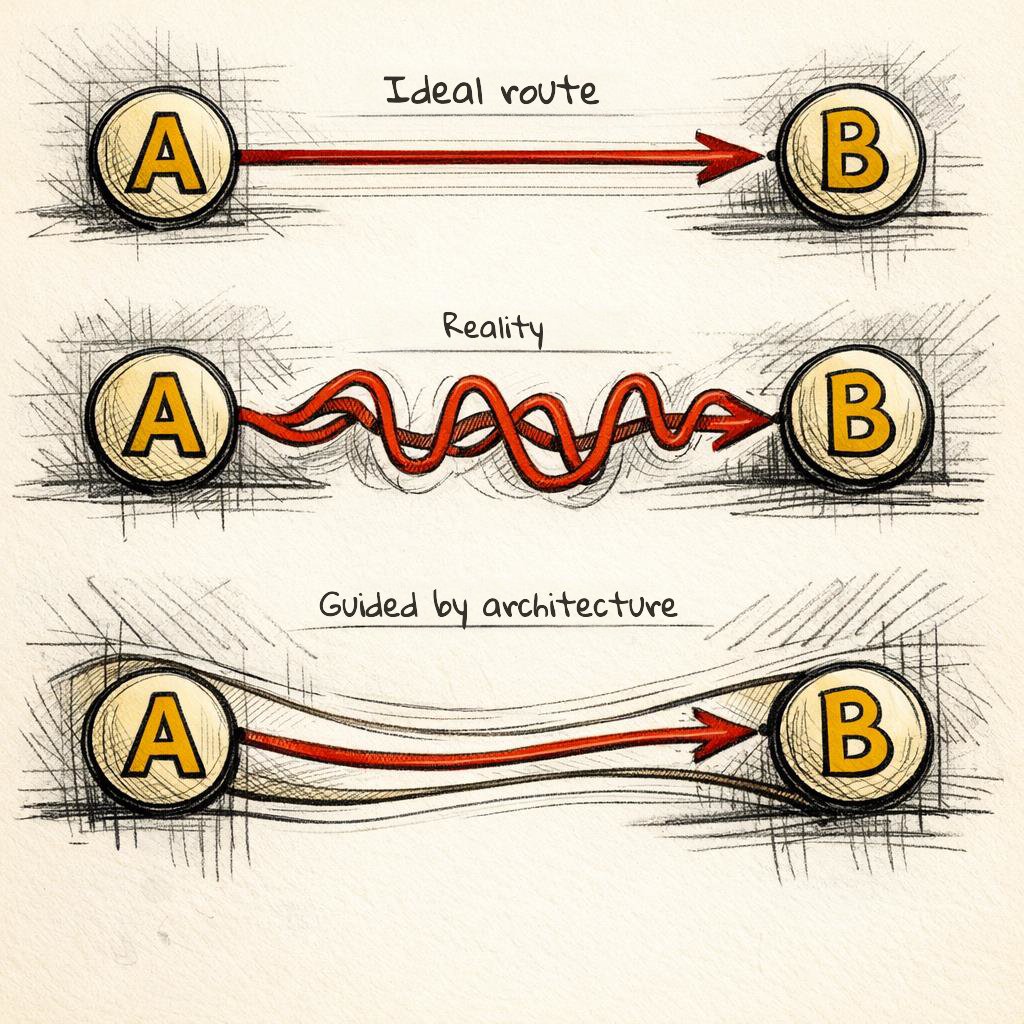
I like to think of the impact of architecture as bounding the daily activity, smoothing out / streamlining those activities – saving time, money and reducing wasted effort.
Actions
The following bullets are designed to give you a small simple list (after all my rambling) on how, as an architect, you can help your organisation go faster:
- Agile – use roadmaps and epics as a common language to keep stakeholders moving with you
- Focused – ask should we add a feature / technology – not just add it because we could
- Automate, automate, automate – this is the only way to confidently make a big change quickly
- Communicate – don’t speak Klingon
- Loosely couple – segment your design, ensuring isolation and enabling independent cadence
- Backlog it – move functionality there to speed up delivery, but keep the learning
- Follow the money – if there is no budget, it’s not going to happen
- AI – use it, don’t get left behind, and use it ethically

This is the concluding part, explore the previous parts: